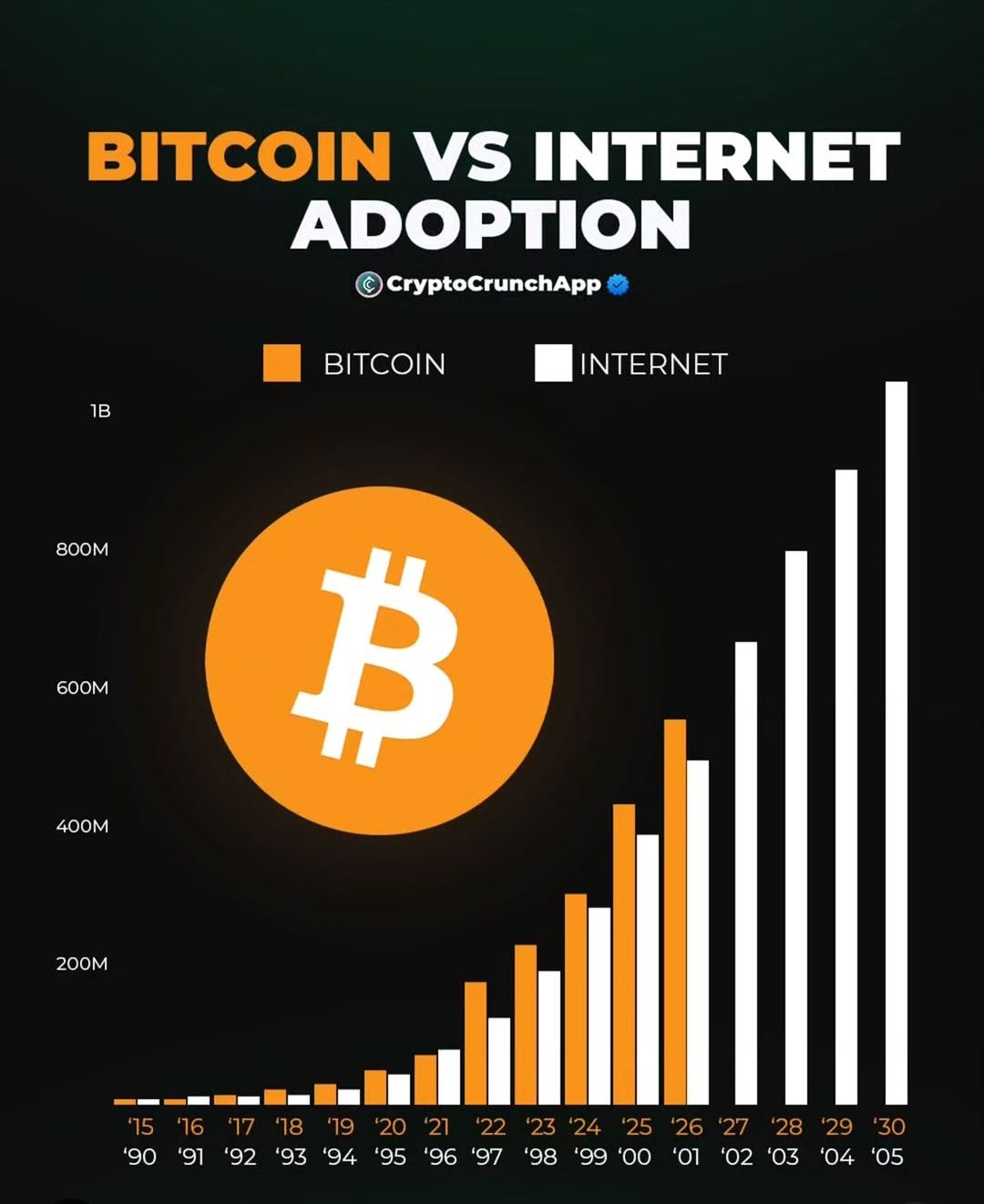
There Is No Bear Market in Bitcoin Adoption


Bitcoin may be trading 50% below its all-time highs, but adoption continues to compound beneath the surface. Price and fundamentals are often disconnected in the short term. What matters is whether network participation, infrastructure, and capital allocation are expanding.
Here are eight structural adoption trends shaping the long-term trajectory of Bitcoin.
1. Institutional Accumulation Reached Record Levels
Institutions accumulated approximately 829,000 BTC in 2025, spanning corporations, governments, funds, and exchange-traded products.
This capital represents millions of individuals gaining exposure through brokerage accounts, retirement plans, sovereign wealth funds, and corporate balance sheets. Institutional demand does not eliminate individual ownership — it broadens access.
Much of the 2025 sell-side liquidity came from long-term holders and early adopters distributing into a deeper market. Despite growing institutional participation, individuals still control roughly two-thirds of total supply, meaning they continue to influence marginal price discovery.
If current trends persist, institutions could hold a majority share within a decade. But retail and self-custody participants remain foundational to Bitcoin’s ownership structure.
2. Investment Advisors Have Been Net Buyers for Eight Consecutive Quarters
Registered Investment Advisors (RIAs), who collectively oversee an estimated $146 trillion in assets, only began allocating meaningfully after spot ETFs launched in 2024.
Even at this early stage:
RIAs have added roughly $1.5 billion per quarter into Bitcoin ETFs for two years.
There has not been a single net-selling quarter.
29 of the top 30 U.S. RIAs now hold exposure.
The average allocation remains extremely small at just 0.008%.
Adoption is broad but shallow — which implies substantial room for future expansion as allocations normalize.
3. Major U.S. Banks Are Building Bitcoin Products
Roughly 60% of top U.S. banks are developing custody or Bitcoin-related financial products. A clearer regulatory backdrop has enabled banks to move from observation to integration.
Institutional-grade custody and banking integration significantly lower barriers for high-net-worth individuals and corporations to participate.
4. Public Company Adoption Grew 2.5× in 2025
Corporate balance sheet adoption accelerated sharply in 2025. Treasury-focused firms led purchases, but accumulation is no longer limited to single-strategy companies.
An increasing number of large corporations are allocating smaller, strategic portions of reserves to Bitcoin. This mirrors the early phases of gold treasury adoption in prior decades.
Should this trend expand across major indices like the S&P 500, even modest allocations would represent substantial structural demand.
5. Merchant Adoption Increased 74%
Bitcoin payments adoption grew 74% globally in 2025, with the number of U.S. businesses accepting BTC roughly tripling.
Brands such as Steak 'n Shake have demonstrated that Bitcoin can reduce payment processing costs and improve margins.
Much of this growth is occurring among small and privately held businesses that do not publicly disclose their strategies. Payment adoption tends to be bottom-up before it becomes headline-driven.
6. The Lightning Network Expanded Rapidly
The Lightning Network saw estimated growth of 300% in 2025, with monthly transaction volume surpassing $1.1 billion.
This expansion is largely organic, driven by exchanges, merchants, and payment processors integrating faster, lower-cost Bitcoin settlement.
Layer-2 scaling growth reflects real-world usage, not speculative trading activity — a key distinction for long-term network health.
7. Nation-State Ownership Continued to Grow
Five additional nation-states accumulated Bitcoin in 2025 through mining, direct purchases, ETFs, donations, seizures, and other state-linked strategies.
New sovereign participants included investment entities tied to Luxembourg and Saudi Arabia, along with central bank-level exposure in the Czech Republic.
It has now been four years since any country enacted a full ban, with Afghanistan in 2022 being the most recent example.
Policy posture has shifted from prohibition to strategic engagement.
8. Volatility Continues to Decline
Bitcoin’s long-term volatility trend has steadily declined over the past decade, increasingly resembling mature asset classes such as Gold and the S&P 500.
Lower volatility reduces barriers for conservative capital pools including pensions, insurance funds, and institutional allocators.
The most recent cycle demonstrated this shift clearly: more capital flowed into Bitcoin over a three-year period than in all prior history combined.
Looking Ahead to 2026 and Beyond
Short-term price performance often obscures structural progress. The current phase of adoption is not speculative mania — it is institutional integration, sovereign positioning, payment infrastructure growth, and treasury diversification.
That type of adoption rarely produces overnight price multiples. Instead, it builds durable foundations:
Deeper liquidity
Broader ownership distribution
Stronger regulatory clarity
More resilient infrastructure
Each year, participation expands across individuals, businesses, institutions, and governments. Trust compounds through usage, custody improvements, and financial integration.
Market cycles will continue. Volatility will remain part of the journey.
But the data suggests something important:
There may be bear markets in price.
There is no bear market in Bitcoin adoption.